
Why Blanket Your Horse?
Horse blanketing can be a polarizing subject. Some people think horses don’t need blankets, while others can’t imagine their horse going without one in the winter. Online discussions of the subject can get heated. Who is right?
They both are.
Most healthy horses, with proper feed and access to adequate shelter, will be just fine in even the coldest of temperatures without a blanket, as long as nothing has prevented them from growing their full, natural winter coat. But it is important to pay attention to those conditions.
First of all, the winter coat. Did you know that the shortening days are what trigger a horse to shed its summer coat and begin growing the winter coat? Likewise, the cooler temperatures, especially cold nighttime temperatures, stimulate longer hair growth. If you have ever noticed your horse beginning to look shaggy in August and wondered why, it is usually because there were a few cooler than normal nights, helped along by the already shortening daylight as we head towards the fall equinox. Exposed to natural seasonal conditions, your horse should be well prepared for winter, but if your horse is in a warm barn overnight or is subject to timed lighting, he may not grow nearly as long of a coat.
What is proper feed? Many people think their horses need extra grain when it’s colder outside, and it’s true that the extra calories may be necessary if his Body Condition Score is below a 5, but it is having enough hay that is most important. The process of digesting hay in particular produces a lot of internal heat for your horse. Your outdoor horse especially may need access to free-choice hay in the winter. If you ration your horse’s hay, plan to give extra when there is a cold snap.
As for shelter, your horse needs a way to get out of not only the snow and rain but the wind as well. There is actually a great deal of difference between 20 degrees below zero on a still morning and being exposed to a wind chill of 20 degrees below zero when it comes to your horse’s comfort and warmth. Your horse’s winter coat is not wind proof and will insulate much more effectively in calm conditions than in a wind.
If horses do fine without blankets, then why would anyone blanket their horse?
The fact of the matter is, all that is just fine for horses who sit idle in the pasture all winter, but if your horse is worked hard enough to begin sweating you don’t want a full winter coat on him. A damp coat creates an entirely different set of problems. Blanketing allows us to keep our horses comfortable in changing weather as well as changing workloads. Here are reasons you might not only want but need to blanket your horse.
Your horse lives in a heated barn. If your horse is in a climate-controlled situation when inside and still turned out in all or most weather conditions, it would be unfair to leave him naked in a significant temperature change. The warmer ambient temperature will prevent him from growing as thick of a coat and he will not be prepared for extreme cold. The need for blanketing will not change much whether the barn is heated to 50 or 70 degrees, but it will of course affect if or how warmly he should be blanketed in various weather conditions.
Your horse is exposed to timed lights. Since shortening days are largely responsible for winter hair growth, if your barn has timed lights and therefore a consistent length of “day,” your horse will not grow his full coat.
Your horse is worked all winter. Imagine you were dressed very comfortably for sitting around on a cold day, and then went for a run instead. Imagine you weren’t able or allowed to take off your winter coat or hat and gloves while you worked out. Think of how uncomfortably warm and sweaty you would get, and then how it would be even worse as you stopped working and that sweat began to dry, cooling you rapidly until you were shivering! Blanketing allows us to remove your horse’s winter clothes for hard work and put them back on when he’s done.
Your horse is clipped. This one really could go without saying. Clipping is one way to prevent your horse from sweating while he’s worked. If your horse has had his winter coat removed, he obviously will need supplemental protection from the elements.
You show your horse, even in winter. If you don’t take the winter off and not only work your horse but travel to shows, I probably don’t need to tell you that you don’t want a fuzzy horse. Chances are, you already keep your horse somewhere that is both heated and in timed lights because you are keeping your horse summer-slick all year round, and you know that if he gets a little chilly he will fuzz up in a hurry.
Your horse is older, less healthy, can’t fully get out of the wind or wet while outside, moved from a warmer climate, or just plain hates the cold. You know your own horse. Some horses may have trouble maintaining their body temperature and need a little help. Be confident in your choice to blanket (or not) as long as you are paying attention to your individual horse’s actual needs. If you listen, your horse will tell you what he needs.
Remember that if you choose to blanket your horse, you will need to be vigilant about temperature changes and keeping him from becoming warm enough that he starts to sweat under his blanket. Please don’t throw a blanket on your horse and ignore him for a week at a time. If you are unable to be attentive to his comfort on a regular basis, it is better to leave him unblanketed and allowed to grow his own winter protection. If you are going to prevent him from having a full coat or can't meet the basic requirements to keep him dry, well-fed, and out of the wind, plan to blanket and check on him regularly.
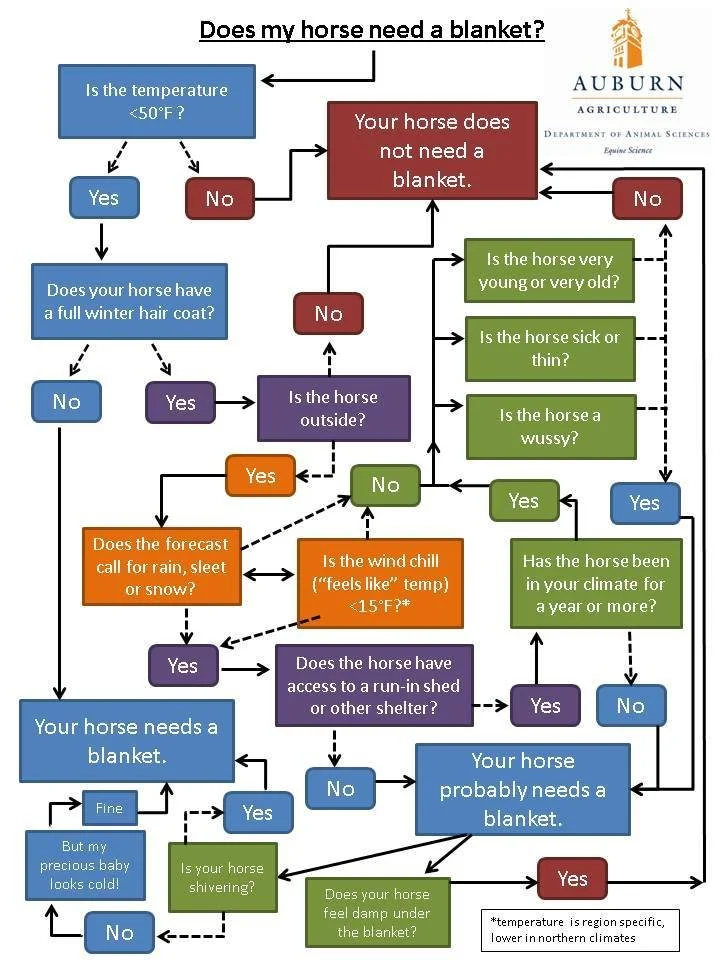
Credit Dr Betsy Wagner/Auburn University
*note “blanketing” implies insulation. You may want a waterproof sheet with no fill for temperatures above 50 degrees.